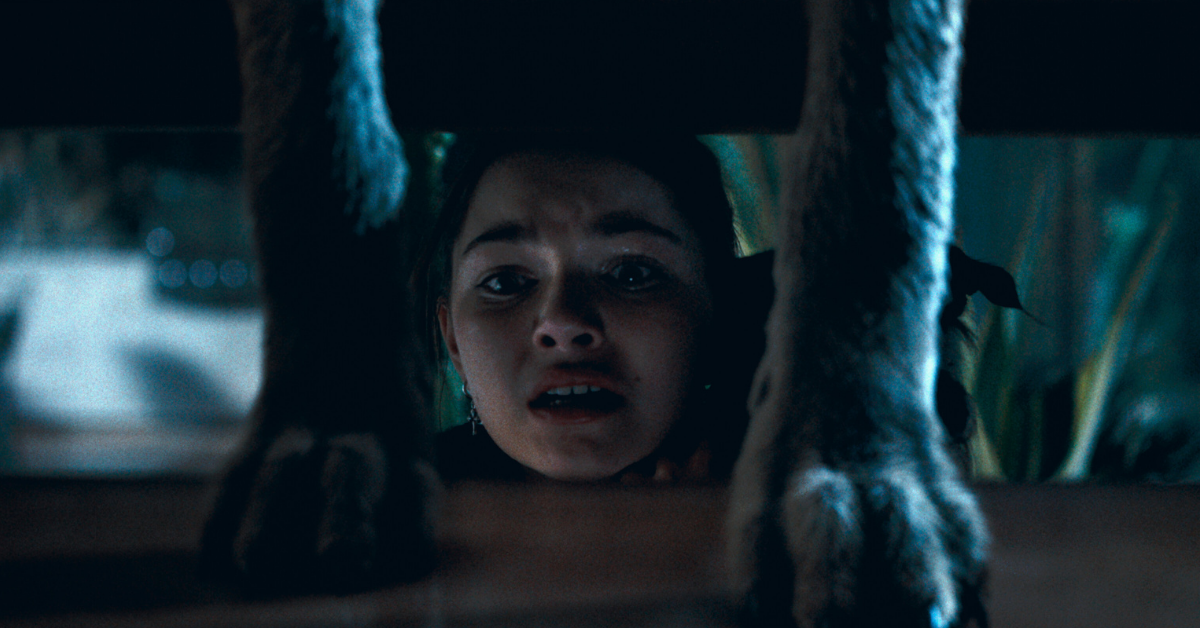

A deceptively quiet aquatic thriller, Dangerous Animals (2025), directed by Sean Byrne, lures audiences in with understated tension and an undeniably charismatic protagonist. Within its restrained pacing are character studies of obsession, ritual, and survival anchored by compelling performances. While Jai Courtney delivers a convincing turn as Tucker, a shark-obsessed psychopath, it’s Zephyr (Hassie Harrison) who emerges as the steadfast anchor of the film — through sheer willpower, she reclaims her agency from Tucker’s patriarchal violence in the most brutal ways possible.
Courtney inhabits Tucker with unnerving perfection, a man whose infatuation with sharks mutates into a ritual of conquest. His deranged alcohol fueled dance around his boat in nothing but a kimono and his underwear, a comedic echo of Buffalo Bill in Silence of the Lambs (1991) — it would have been even more delectable underscored by Q Lazzarus’ “Goodbye Horses.” He gently tends to his shrine of brutality, a collection of VHS tapes cataloging his obsession, identifying his tapes with locks of hair crafted into fishing lures. Filming the carnage of his victims’ last moments transforms his ritualistic violence into a performance. Tucker isn’t merely a predatory trophy hunter; he’s a patriarchal figure weaponizing nature to assert control.
Zephyr’s journey transforms the film from a predator’s unchecked playground into a survivor’s reclamation. She is her oppressor’s equal, prevailing through mental fortitude and a willingness to do anything to survive while dismantling his carefully constructed cycle of power and patriarchal violence. Her resilience echoes the “final girl” as a feminist icon, rooted in the fight for bodily integrity and agency. In her most harrowing moment — a sequence of self-mutilation reminiscent of Jessie’s escape in Gerald’s Game (2017), an act of radical self-liberation that solidifies her refusal to be reduced to prey. Her body becomes both the battleground and the weapon, her blood and pain fueling escape rather than defeat.

Zephyr is cunning, unyielding, and unforgettable. She endures, adapts, and fights with a clarity that positions her not as a victim defined by the violence perpetrated against her but as a survivor who strips Tucker of his power by refusing to break. Her resilience is the very weapon strong enough to break him down psychologically, leaving him vulnerable to defeat.
The film is not about sharks. They serve merely as a metaphor for untamed power, primal nature, and predatory instincts — the character traits that Tucker so desperately hopes to emulate through his patriarchal and obsessive ceremonial killings. Tucker embodies male violence as performance: stalking, killing, and documenting his savagery with a precision that reframes his victims as objects, in this instance, chum for consumption in shark-infested waters. The feeding itself is an extension of his desire for dominion over every other living creature, specifically women.
Zephyr’s triumph over his dominion reframes the narrative entirely. Her survival disrupts Tucker’s cycle of violence by interrupting his dearly held rituals. The film subverts the male gaze and reminds us that horror often finds its sharpest edge when women reclaim control of their own stories.

The film hits rough waters with a romantic subplot that feels unnecessary and forced, softening our strong female character and diminishing the tension that should remain raw. However, it’s important to note that while Moses (Josh Heuston) comes to the rescue, he’s no more capable of “saving the day” than Zephyr. While “Ooby Dooby, motherfucker!” is undoubtedly one of the best one-liners intended to echo Jaws (1975) and Brody’s iconic, “Smile, you son of a bitch!” — the underlying romance and fast-formed devotion Moses and Zephyr share feels idealistic. It’s as if Byrne is expecting to cater to a female audience, presuming that a desire for romance is inherent, which is diminishing all on its own.
Despite minor missteps, Dangerous Animals is an engaging thriller redeemed by Zephyr’s arc and the film’s commentary on patriarchal violence. Jai Courtney’s Tucker is deranged with comedic notes that make him a villain you almost want to root for. Though the romance subplot falters and the pacing drifts, the film’s unnerving themes and Zephyr’s unforgettable fight for survival cement it as a standout entry in feminist survival horror.